
Car ownership transfer in Spain: steps and documents
Organise vehicle checks, the contract, tax and ownership-change application for an ordinary private used-car sale in Spain.

Published on:
Updated on:
How to transfer car ownership in Spain: the order of work
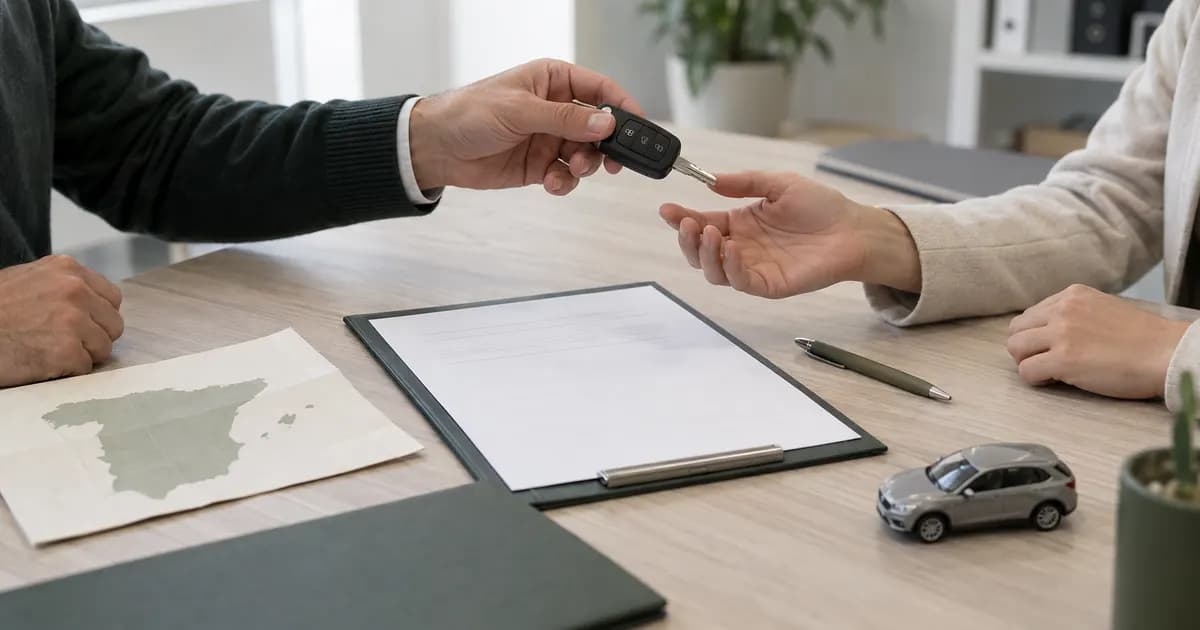
For an ordinary sale between private individuals, prepare the vehicle checks, sign a clear contract, obtain the appropriate tax evidence and apply for the ownership change. Handing over the keys is separate from registering the buyer. The DGT describes the official documents and application; this guide organises the work so you can distinguish a filing receipt from the new vehicle registration certificate.
DGT is Spain's traffic authority. The Spanish terms cambio de titularidad (ownership change), permiso de circulación (vehicle registration certificate) and tarjeta ITV (technical inspection card) identify different documents and stages. The registration certificate is separate from your driving licence.
The following route does not cover inheritance, gifts, imports or transactions with special circumstances. If there is a recorded charge or a missing document, identify the problem first: repeating an application without resolving it can create more work. An ownership transfer also does not establish that the car is mechanically sound.
Before signing: four checks
Identity and vehicle
Compare the seller's identity with the documents supplied. Check the number plate, make, model and details of the car you are actually buying. Ask for clarification before entering them in the contract; one incorrect letter can affect several documents. Keep a legible copy of the document used in the case and avoid distributing it beyond the necessary channels.
Administrative status and actual condition
Check the administrative information and examine any warning. The official used-vehicle buying guide recommends checking the vehicle's status. A favourable report does not replace a mechanical inspection. If a restriction appears, do not automatically read it as permission or prohibition: establish what it is and what the particular situation requires.
Handover arrangements
Decide when the car, keys and documents will be handed over, how payment will be evidenced and who keeps each copy. Record known issues and included items too. A later conversation is harder to reconstruct than an agreement organised before handover.
Tax and filing channel
Identify the competent tax administration and check its instructions. ITP, Spain's property transfer tax, is separate from the traffic authority's fee. For official online filing, check the identification system required; if a representative acts, confirm how they must establish that authority. Do not give your personal login credentials to the seller or an intermediary.
Ownership-transfer checklist for both parties
| Stage | Buyer | Seller |
|---|---|---|
| Preparation | Check the car, report and details | Gather documents and clarify issues |
| Signing | Check price, date, time and signatures | Keep a complete contract copy |
| Tax | Obtain the appropriate evidence | Supply the necessary documents |
| Traffic authority | Apply for the ownership change | Consider and carry out sale notification |
| Follow-up | Keep the receipt and answer requests | Keep proof of the notification |
This is an organisational guide. The particular obligations and documents depend on the transaction. Do not use the table to replace the official instructions for a special case.
Decide whether the ordinary route fits
Before filing, use this checklist to organise your decision rather than approve the case automatically. This guide starts with a private sale whose parties and vehicle are identified. If a check remains open, record what is missing and who can establish it; do not hide it under another contract copy.
| Check | If clarified | If pending |
|---|---|---|
| Seller and buyer | Compare identity in the contract and documents | Clarify ownership or representation before reusing the data |
| Vehicle and documents | Check number plate and details match | Find the discrepancy or missing document |
| Administrative issue | Keep the explanation and supporting documents | Check its meaning and required action; do not infer its effect from its name alone |
| Tax | Prepare the evidence for this transaction | Confirm the administration and treatment before filing |
| Type of transfer | Continue with the ordinary sale described | Find the specific instructions for inheritance, a gift, an import or another special case |
Hypothetical case: buyer and seller have legible copies and matching details, but cannot interpret a warning from an administrative check. The next task is to clarify that warning using its supporting documents and the competent channel. Completing the price or paying for assistance does not resolve the uncertainty. If the only problem is an illegible copy and the rest is clear, prepare a correct copy and retain the case reference to answer the relevant request.
This comparison does not declare a particular vehicle transferable or turn one issue into a universal prohibition. It distinguishes a file that needs correction from a question requiring procedural checks. The DGT buying guide remains the reference for administrative checks.
Prepare the application and keep proof
- Sign the contract after checking every detail. DGT recommends identifying the parties and vehicle, recording price, date and time, and signing each sheet.
- Obtain evidence of payment, exemption or non-liability for the relevant tax. Check the details match the contract.
- Prepare the application, attachments and proof of the applicable fee for your chosen channel.
- Review files before filing: complete, legible and for this car.
- Keep the filing receipt and reference number. Answer requests within that case rather than assuming it is complete.
- Check the result and issued documents. Sending an application does not justify promising an immediate decision.
Under the General Vehicle Regulations, in the ordinary case the buyer must apply within thirty days and the seller has a separate notification obligation within ten days. These deadlines govern the parties' actions, rather than guarantee administrative processing time.
Example: a sale with complete documents
Hypothetical case: Lucía buys a used car from Andrés. Before handing over the keys, they compare the vehicle with the contract and keep signed copies recording handover time. Lucía prepares the tax evidence and applies for the ownership change. Andrés keeps his contract and notifies the sale. Each keeps their own receipt: neither assumes the other's document proves their own action.
If Lucía receives a request because a copy is hard to read, she responds within the case. Filing on a given date does not make that file correct or guarantee issuance of the new certificate. This example explains the division of work without assuming a completion time or service price.
Mistakes to avoid
- Leaving contract boxes blank to complete later.
- Confusing an ITP estimate with the total transfer quote.
- Treating payment of a fee as completion.
- Using the seller's notification in place of the buyer's application.
- Driving without checking the car meets the required conditions.
DGT distinguishes transfer from driving: an expired ITV inspection does not authorise you to drive to the testing station; transport the vehicle by an authorised means. Resolve those arrangements before handover if this applies.
Official channel or assistance?
You can organise and submit through the applicable official channel or use assistance to prepare the case. In either route, establish who files, which documents are missing and what each cost includes. Registration is the administration's responsibility; no universal twenty-four-hour promise applies. Begin with a document list and a check of your circumstances rather than a promised delivery date.
What is the first step in a vehicle transfer?
Gather the contract, both parties' identification and the vehicle documents before filing. Check the administrative status and applicable tax procedure, then follow the filing sequence in this guide. If you want assistance, read the documents and scope of the online transfer service. Keep evidence of each stage and check the ownership-change result.
Sources and next steps
Official sources corroborated on 1 October 2026. External official pages linked here are published in Spanish:
Prepare the sale contract, estimate only the ITP, or consult the transfer service for assistance. The guided service requires an account; check the quote and any pending documents or signatures before treating the case as complete.
Sources consulted
Related resources
Keep reading
- Buying and selling

Car sale contract: mistakes to check before signing
Check identity, vehicle details, payment, handover and signatures, with examples for finding ambiguous wording before preparing a private car sale contract.
Read more - Documents and procedures

DGT appointments: when you need one for a procedure
Check the office, channel, representation and exceptions. Booking is free, and some digital procedures have their own instructions.
Read more - Buying and selling
Transferencia24 and alternatives: comparing online assistance
A dated comparison of channels, quotes, documents and follow-up described by Transferencia24, Tramicar, GestoriaDGT and Synexis.
Read more - Documents and procedures
Vehicle registration and re-registration in Spain: official routes
Identify which application you need before preparing documents, paying a fee or ordering new plates.
Read more - Buying and selling

Sale notification and ownership transfer: each party’s role
Organise the seller’s notification and buyer’s ownership change, with dates, receipts and an example explaining why notification is not retroactive.
Read more